

Votre Pièce de Théâtre et l'IA
Votre Pièce de Théâtre et l'IA
Walid Bergaoui
Log in to comment.
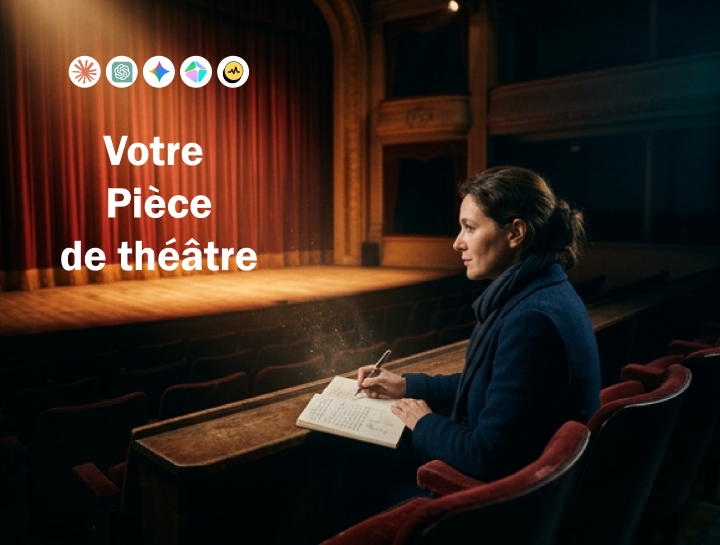
You have a story that's asking to be performed — characters who speak, silences that carry weight, a scene you can already picture. This training gives you the power to write it and carry it all the way to the boards of a theater. You are the artist: your story, your characters, and your lines remain at the heart of everything. What you learn here is how to direct powerful AI tools — Claude, Claude Code, OpenAI, Gemini, Firefly, HeyGen, TTSMaker — to transform your vision into a polished play, ready to be read and presented to a company.
The approach is hands-on. You begin by mastering your tools — understanding AI, setting up your environments, the art of the prompt, organizing your projects, and collaboration between agents — so you take control rather than being controlled. You then build your play: a structure in acts and scenes designed for the stage, characters and arcs, and the heart of theater — the line, the monologue, the subtext — before bringing the manuscript up to standard and putting together the presentation packet. And because in theater every word is spoken aloud, you learn to audit your text with AI: repetitions, overly long sentences, the balance of scenes and of your characters' presence.
By the end of the program, you walk away with a complete, professionally formatted play, a presentation packet, and a lively first reading of your text — ready to win over a company — along with a mastery of the tools that will serve all your future work. You will have written and directed everything yourself, from the first line to the final curtain: AI will have been nothing more than the formidable lever for your talent. Because the work bears only one signature — yours.
Your text deserves to be discovered. Once your play is written, BSF gives it the stage and the audience:
Free hosting — your play is published online on BSF, at no cost.
Your personal page — a showcase in your name to gather all your plays.
A real audience — your readers discover you, react (emojis, comments) and share your play on the BSF social network, Facebook, and other networks.
You are the artist: we train you to direct powerful AI tools to write your play and carry it to a company. The journey begins with mastering the tools, then applies them to your play, all the way to the audit that brings it to its best.
1. AI, how it works and its limits — models, memory and context, compaction, hallucination, validation. The principle: you are the artist, AI is the tool.
2. Setting up your environments — Claude Desktop, Claude Code, Codex, Gemini CLI, Claude Browser; and the basics of HTML to understand your exports.
3. The art of the prompt — giving clear instructions to get exactly what you want.
4. Organizing your projects for AI — reference files and MD files: the « memory » of your project, for consistent results.
5. Making multiple agents collaborate — agents and tester agents, the validation system, and the mistake never to make (two agents on the same task).
6. Creative tools, rights & watermark — TTSMaker, HeyGen, Firefly, Adobe Stock: uses, usage rights, and ownership of your creations.
7. Dramatic structure — building your play in acts and scenes.
8. Thinking for the stage — crafting a performable narrative: set, entrances and exits, the constraints of the stage.
9. Your characters — complete profiles: traits, motivations, and dramatic arcs.
10. The art of the line — living dialogue and monologues, charged with subtext, with distinct voices.
11. Rhythm & stage presence — calibrating duration, balancing entrances and exits and each character's presence.
12. The theatrical manuscript — bringing your text up to standard (stage directions, lines, cast) and exporting it as a clean PDF.
13. The packet & visual world — synopsis and director's statement for a company, a moodboard for the set, the staging, and the costumes.
14. Auditing your play — repetitions and overly long sentences in the dialogue, the balance of scenes and of character presence, the flow of the narrative.
15. The staged reading — having your lines read aloud (dramatized reading) with TTSMaker, and adding sound atmospheres.
16. Showing & presenting — short video sequences (HeyGen) and assembling a presentation to carry your play to a company.
Publish it for free on BSF: your work online, your own author page, your audience.
Publish my workVotre Pièce de Théâtre et l'IA
Votre Pièce de Théâtre et l'IALog in to comment.
Be the first to comment.