

Pensée Critique & Résolution de Problèmes
Pensée Critique & Résolution de Problèmes
Walid Bergaoui
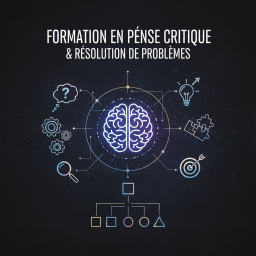
Every day, you make decisions, settle debates, and react to information pouring in from all directions. But how many of those choices truly rest on rigorous thinking, and how many on reflexes, emotions, or received ideas? This program gives you what separates those who endure problems from those who solve them: clear, methodical, and independent thinking. You learn to think for yourself, to see beyond appearances, and to turn confusion into solid decisions.
The approach is concrete and demanding. You first discover the foundations of critical thinking: telling a fact from an opinion, spotting the traps in your own brain — cognitive biases, misleading shortcuts, flawed reasoning — and assessing the reliability of a source. You then learn to break down an argument, to detect fallacies and manipulation, and to frame a problem properly before solving it. Because a well-defined problem is already half solved: you will master proven methods to dig into causes, generate solutions, and choose the best one with full clarity.
By the end of the program, you will never look at information, debates, or difficulties the same way again. You will know how to analyze a complex situation calmly, argue rigorously, see through misleading reasoning, and make decisions you can defend. These skills aren't just for work: they strengthen your independence of judgment throughout your life. With every problem, you will now have a method — and the confidence of a mind that knows how to reason.
Far more than concepts: a mental toolkit you'll keep for life.
A problem-solving method — a clear, step-by-step process you can apply to any problem, from the simplest to the most complex.
A trap-detection radar — the ability to instantly spot biases, fallacies, and manipulation in a message or a piece of information.
A decision-making framework — a concrete tool to compare options, weigh the pros and cons, and choose with confidence.
A progressive path: first you build up your critical thinking — thinking clearly, avoiding the traps, evaluating information — then you put it to work through a problem-solving method that you'll apply to a real case.
1. What does it really mean to think? — what critical thinking is, why it has become essential, and the difference between believing, knowing, and understanding.
2. Fact, opinion, interpretation — telling what is verifiable from what is felt or assumed, and asking the right questions before passing judgment.
3. The traps in your brain — the main cognitive biases (confirmation, anchoring, groupthink…) and how to recognize them in yourself.
4. Anatomy of an argument — distinguishing premises from conclusion, testing the soundness of a line of reasoning, deduction and induction.
5. Fallacies and manipulation — spotting misleading reasoning (straw man, false dilemma, appeal to emotion…) and responding to it.
6. Evaluating a source — judging the reliability of a piece of information, cross-checking sources, and keeping a cool head in the face of fake news.
7. Framing the problem well — rephrasing, scoping, and clarifying: a well-defined problem is already half solved.
8. Finding the real causes — getting to the root with simple tools (the 5 Whys, cause tree) instead of treating the symptoms.
9. Generating and choosing solutions — producing options without self-censoring, then deciding with a clear set of criteria.
10. A real case from A to Z — you apply the whole approach to a concrete problem: analyze, reason, decide, and defend your conclusion.
Pensée Critique & Résolution de Problèmes
Pensée Critique & Résolution de Problèmes
No comments yet.
Log in to comment.