

Gestion de Projet et Méthodes Agiles
Gestion de Projet et Méthodes Agiles
Walid Bergaoui
Log in to comment.
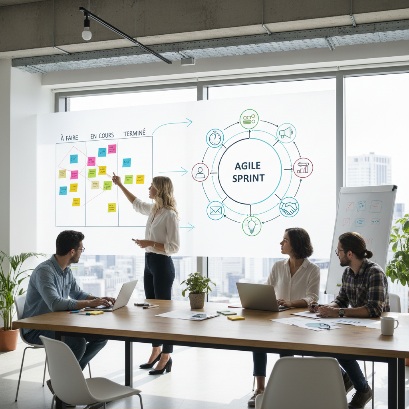
A project is a promise: to deliver the right thing, at the right time, without burning out your team. Yet too many projects go off the rails — deadlines slip, budgets balloon, teams lose motivation. This training gives you the instincts and tools to take back control: clearly framing a project, planning it realistically, steering its progress, and staying on course when the unexpected happens. You walk away with a complete method, from the fundamentals of project management to the agility that transforms the way you work together.
The approach is decidedly hands-on. You start by laying the foundations — defining the scope, objectives, stakeholders, and risks — then you learn to break down the work, estimate, plan, and track a budget. Next, you discover the agile mindset and its most widely used frameworks: Scrum with its roles, events, and artifacts; Kanban and flow visualization; writing user stories and prioritizing value. Every concept is grounded in role-plays, workshops, and case studies drawn from the reality of Tunisian and international organizations.
By the end of the program, you know how to choose the right approach for the context — predictive, agile, or hybrid — run the key ceremonies, facilitate your team, and measure a project's performance by the value delivered, not just the hours spent. You leave with a ready-to-use toolbox and an action plan tailored to your environment, capable of turning every project into a collective, lasting success.
Far more than concepts: deliverables you can put to use on your projects first thing Monday morning.
A complete toolbox — ready-to-use templates for the project charter, schedule, backlog, Kanban board, and metrics.
A decision framework — knowing when to choose predictive, agile, or hybrid based on your project and your team.
A personalized action plan — your first agile ceremonies and team rituals, tailored to your industry.
A progressive journey: first we lay the fundamentals of project management, then we learn to steer and master, before shifting into agility — Scrum and Kanban — and finally equipping and grounding it all in your environment.
1. What is a project? — project, program, portfolio; the golden triangle of cost-time-quality; the life cycle and the role of the project manager.
2. Frame the project — defining the scope, SMART objectives, deliverables, and success criteria; writing the project charter.
3. Stakeholders & risks — identifying and mapping the players, anticipating risks, and building a response plan.
4. Break down & estimate — building the WBS (work breakdown structure), estimating effort and durations, identifying dependencies.
5. Schedule & critical path — building a realistic schedule, the Gantt chart, the critical path, and milestones.
6. Budget & resources — estimating and tracking the budget, allocating resources, and leveling the team's workload.
7. Tracking & steering — dashboards and metrics, managing variances and changes, clear reporting to decision-makers.
8. The agile mindset — the Agile Manifesto, its 4 values and 12 principles; predictive, agile, or hybrid: when to choose what.
9. Scrum: roles & artifacts — Product Owner, Scrum Master, development team; product backlog, sprint backlog, and increment.
10. Scrum: the events — sprint planning, daily, review, and retrospective; running a sprint from start to finish.
11. User stories & prioritization — writing clear stories, the "definition of done," estimating in points, and prioritizing by value (MoSCoW).
12. Kanban & flow — visualizing the work, limiting work in progress (WIP), smoothing the flow, and reading velocity.
13. Tools & collaboration — managing projects and backlogs with tools like Trello, Jira, or Notion; boards, automations, and remote work.
14. Practical case & action plan — applying the method to a real project, choosing your approach, and walking away with your personalized action plan.
Gestion de Projet et Méthodes Agiles
Gestion de Projet et Méthodes AgilesLog in to comment.
Be the first to comment.