

Intelligence Artificielle en Entreprise : Automatiser, analyser, décider mieux
Intelligence Artificielle en Entreprise : Automatiser, analyser, décider mieux
Walid Bergaoui
Log in to comment.
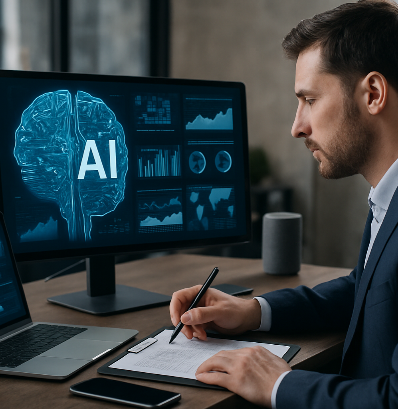
Artificial intelligence is no longer a distant promise: it is already at work in the companies that have learned to harness it. This training teaches you to put it to work for yours — not to follow a trend, but to automate what wastes your time, read your data like a strategic map, and decide faster and more accurately. You don't need to be an engineer: you learn to drive AI as a decision-maker, to know what it can do, what it cannot do, and where it truly creates value.
The approach is concrete and results-oriented. You start from real cases in your own business — data entry, follow-ups, document sorting, classification, reporting — to automate repetitive tasks and free up your teams. You then discover how to turn data into anticipation: forecasting sales, detecting customer risks, anticipating demand, spotting a breakdown before it happens. At every step, you connect the technology to an operational decision, because a useful AI is an AI that changes what you do Monday morning.
But succeeding with AI isn't just about choosing a tool: it means integrating it into your systems, governing your data, training your teams, and building trust. So you also learn to scope a project, protect confidentiality, keep humans in the loop, and deploy an AI that is ethical and adopted. By the end of the journey, you leave with a clear roadmap, prioritized and quantified use cases, and the ability to turn AI into a lasting competitive advantage — precision, intelligence, and speed in service of your decisions.
This training doesn't stop at theory: it puts in your hands what you need to act the very next day.
Your AI roadmap — a mapping of your priority use cases, quantified and ranked by impact and feasibility.
Ready-to-use automations — concrete workflows for your repetitive tasks, tested on your own data.
A predictive dashboard — an analysis model to anticipate sales, risks, or demand, readable by your teams.
A governance charter — the usage, security, and ethics rules to deploy AI with confidence across your organization.
A journey that starts from the foundations and goes all the way to deployment: understanding AI, automating daily work, anticipating through data, deciding better, then integrating and governing. Each session builds on concrete business cases.
1. AI in business: what it really does — generative AI, machine learning, automation: a clear overview of what it can do, its limits, and the misconceptions around it.
2. Identifying your high-impact use cases — spotting in your processes the tasks and decisions where AI creates value, and prioritizing them by impact and feasibility.
3. Building your AI roadmap — quantifying the expected gains, estimating the effort, sequencing the initiatives, and building a defensible business case.
4. Automating data entry, follow-ups, and sorting — delegating time-consuming tasks to AI: data entry, customer follow-ups, classification, and automatic routing.
5. Intelligent document analysis — extracting, summarizing, and classifying invoices, contracts, and emails; turning stacks of documents into usable data.
6. Designing an automated workflow — chaining the steps, connecting AI to your tools, and making the result reliable: your first end-to-end automation.
7. Preparing and understanding your data — where your data is, how to clean and structure it: without reliable data, there is no reliable AI.
8. Predictive analytics — anticipating sales, demand, customer risks, and potential breakdowns through statistical models and machine learning.
9. Dashboards and visualization — making analysis readable and actionable: KPIs, alerts, and dashboards your teams grasp at a glance.
10. AI in service of decision-making — moving from analysis to action: decision support, scenarios, and the balance between the machine's recommendation and human judgment.
11. Integrating AI and bringing teams on board — connecting to existing systems, required skills, change management: a successful AI is an AI that is adopted.
12. Governance, ethics, and trust — transparency, security, confidentiality, and human control; setting the charter that secures your AI use over the long term.
Intelligence Artificielle en Entreprise : Automatiser, analyser, décider mieux
Intelligence Artificielle en Entreprise : Automatiser, analyser, décider mieuxLog in to comment.
Be the first to comment.